 Refrigeration and freezing
Freezing asparagus and boiling frozen asparagus
Asparagus, also known as the ivory of the kitchen, has been popular for thousands of years. Asparagus (Latin) was first cultivated in Germany in the 16th century and has enjoyed great popularity ever since. Would you like to freeze asparagus so that you can enjoy it out of season? Hints and tips on how to boil frozen asparagus after defrosting can be found here.
The key points
- Only freeze raw asparagus
- Unlike green asparagus, white asparagus must be peeled before freezing
- Woody ends must be removed, especially from white asparagus
- Wash the spears, pat dry and freeze raw
- Cut into small pieces or leave whole, as desired, and place in a freezer bag or container
- Asparagus that has already been frozen should be placed directly into boiling water for preparation
Freezing asparagus
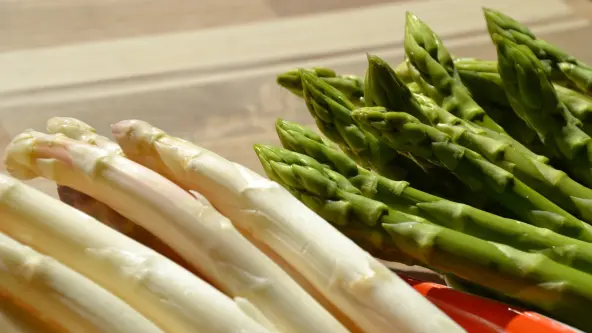
First the good news: with a few of our tips and tricks, it’s not at all difficult to freeze asparagus. And you can freeze not just green but also white asparagus in the freezer. In order to get the crunchiest and most aromatic spears, make sure to use the freshest asparagus. You’ll get the finest sorts directly from the weekly market or your nearest asparagus farmer.
Once you’ve found the perfect candidates, it’s time to prepare them for the freezing process. Green asparagus doesn’t have to be peeled, white does. The vegetables must be washed, peeled, patted dry, and their fibrous ends must be removed beforehand. A swivel-bladed peeler is just the tool for the task. You should always start at the tip, peeling downward toward the end. After they’re peeled, you can freeze the vegetables. But remember: they must be raw. Otherwise, make sure to avoid boiling the asparagus before freezing, as this will cause it to lose its firmness and flavour! Consider creating meal-sized portions or chopping some of them in advance, so you don’t have to thaw them all at once. Airtight freezer bags or containers work great for storing your asparagus. You can keep your green or white asparagus for up to twelve months in your Liebherr freezer compartment, so you can have easy access to regional asparagus all year round.
Freezing asparagus
First the good news: with a few of our tips and tricks, it’s not at all difficult to freeze asparagus. And you can freeze not just green but also white asparagus in the freezer. In order to get the crunchiest and most aromatic spears, make sure to use the freshest asparagus. You’ll get the finest sorts directly from the weekly market or your nearest asparagus farmer.
Once you’ve found the perfect candidates, it’s time to prepare them for the freezing process. Green asparagus doesn’t have to be peeled, white does. The vegetables must be washed, peeled, patted dry, and their fibrous ends must be removed beforehand. A swivel-bladed peeler is just the tool for the task. You should always start at the tip, peeling downward toward the end. After they’re peeled, you can freeze the vegetables. But remember: they must be raw. Otherwise, make sure to avoid boiling the asparagus before freezing, as this will cause it to lose its firmness and flavour! Consider creating meal-sized portions or chopping some of them in advance, so you don’t have to thaw them all at once. Airtight freezer bags or containers work great for storing your asparagus. You can keep your green or white asparagus for up to twelve months in your Liebherr freezer compartment, so you can have easy access to regional asparagus all year round.
Boiling frozen asparagus
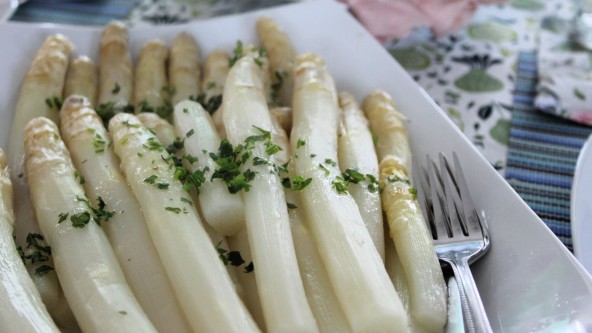
If you want to boil frozen asparagus, it is important not to let it defrost slowly, but to put it straight into boiling water. That way they stay crunchy and retain all their vitamins and flavours. The normal cooking time is 15 minutes. As with fresh asparagus, it is advisable to add a little salt and sugar to the water when boiling frozen asparagus to balance out the bitter flavour. Here’s a little tip: Take a sharp knife and pierce the asparagus to see whether it’s cooked or not. Even if the ends bend slightly downwards when you lift the spears with a fork, this is a sign that they are cooked to perfection.
If you have the option, you can also gently cook frozen asparagus in a steam cooker to achieve a particularly tender result with an exquisite aroma. Of course, asparagus pots are also ideal for preparing this dish. The spears are cooked standing upright in these. This allows the asparagus heads to cook in the steam while the firmer ends remain in the water. In addition, previously frozen asparagus spears can be cooked in the oven. Frozen green asparagus can be sautéed in a pan over a high heat and then cooked over a medium heat until done.
Quick tips for boiling frozen asparagus
- Frozen asparagus should be placed directly into boiling water to preserve its firmness, vitamins and flavour
- The cooking time for frozen asparagus is usually 15 minutes
- It is advisable to add a little salt and sugar to the water to balance out the bitter flavour
- For frozen green asparagus, it is recommended to fry it in a pan and then cook it over a medium heat until done
- There are various methods of preparation, such as steaming, boiling in an asparagus pot and baking in the oven

Storing asparagus
Would you prefer not to freeze all the asparagus straight away, but store some of your raw asparagus? It is important to distinguish between peeled and unpeeled white asparagus. Peeled asparagus can only be stored for a very short time. It should therefore be prepared as quickly as possible. That’s the only way to truly enjoy the wonderful aroma of this popular vegetable. Unpeeled white asparagus is best stored wrapped in a damp tea towel. In your Liebherr fridge, which is ideal for storing vegetables thanks to the BioFresh Fruit & Vegetable safe, you can store asparagus for up to 18 days and keep it fresh. The Fruit & Vegetable safe has high humidity, which keeps the towel moist. Combined with a temperature of just above 0 degrees, your BioFresh safe is therefore an almost ideal place to store asparagus. If you are not storing your asparagus in a BioFresh safe, you should moisten the tea towel regularly.
Even green asparagus stays fresh in your Liebherr BioFresh safe for up to 18 days. If you are not storing green asparagus in a BioFresh safe, it is best to keep it standing upright in a glass of water. Note: the ends of the spears should always remain in water!
Another tip: don’t keep your asparagus next to food that has an intense aroma like garlic and onions or sausage and cheese. Asparagus quickly absorbs the scents of other food.
Storing asparagus
Would you prefer not to freeze all the asparagus straight away, but store some of your raw asparagus? It is important to distinguish between peeled and unpeeled white asparagus. Peeled asparagus can only be stored for a very short time. It should therefore be prepared as quickly as possible. That’s the only way to truly enjoy the wonderful aroma of this popular vegetable. Unpeeled white asparagus is best stored wrapped in a damp tea towel. In your Liebherr fridge, which is ideal for storing vegetables thanks to the BioFresh Fruit & Vegetable safe, you can store asparagus for up to 18 days and keep it fresh. The Fruit & Vegetable safe has high humidity, which keeps the towel moist. Combined with a temperature of just above 0 degrees, your BioFresh safe is therefore an almost ideal place to store asparagus. If you are not storing your asparagus in a BioFresh safe, you should moisten the tea towel regularly.
Even green asparagus stays fresh in your Liebherr BioFresh safe for up to 18 days. If you are not storing green asparagus in a BioFresh safe, it is best to keep it standing upright in a glass of water. Note: the ends of the spears should always remain in water!
Another tip: don’t keep your asparagus next to food that has an intense aroma like garlic and onions or sausage and cheese. Asparagus quickly absorbs the scents of other food.
Quick tips for storing asparagus
- Wrap unpeeled white asparagus in a damp tea towel to store it
- Peeled asparagus should not be stored for long periods if possible in order to preserve its flavour
- The Liebherr BioFresh Fruit & Vegetable safe is an ideal place to store asparagus thanks to its high humidity and low temperature. Here, asparagus can stay fresh for up to 18 days
- Green asparagus can be stored in a glass of water, with the ends submerged.
When does the asparagus season start and end?

Asparagus is available in Germany from mid-April. If you find asparagus in supermarkets before then, it is usually imported. Another possibility is that the asparagus was grown in heated fields in Germany. In both cases, we recommend waiting a few more weeks for the more climate-friendly alternative from regional outdoor cultivation. The asparagus season traditionally ends on St. John’s Day, 24 June. In Germany, this day is also known as ‘Spargelsilvester’ (asparagus New Year’s Eve). This defined end date is important so that the plants can recover properly until the following year.
White asparagus tastes best when it is thick but not woody, white in colour, without green tips, and freshly picked. You can tell how fresh it is by its fresh, uncoloured stalk and pleasant smell. Fresh asparagus has little bend and breaks easily. In addition, the heads of fresh asparagus are usually still closed. But you can also do the listening test: rub two asparagus spears together. If you hear a squeaking sound, that means it’s fresh. Asparagus generally contains a lot of water. It stays fresh for only two days at room temperature, but eight days in the fridge compartment. It stays fresh for up to 18 days in a Liebherr BioFresh safe. How quickly you should prepare and enjoy the vegetables depends on how you store them.
Quick tips for the asparagus season: how to recognise fresh asparagus
- Unblemished stalks
- Characteristic smell
- Little bend
- Squeaks when rubbed together
- Closed asparagus heads
Boiling the asparagus peel
An unavoidable by-product in the preparation of white asparagus is the peels. Since it would be a shame to simply chuck them in the bin, we have a couple of tricks for you, And there’s something here for everyone. The classic, of course, is to make asparagus cream soup from the leftovers. The following ingredients make four portions:
- Peels of roughly 1 kg of asparagus
- 1 l water
- 50 g butter
- 2 tbsp flour
- A pinch of sugar and nutmeg
- Some lemon juice
- Optional: cream and cuts of asparagus or asparagus ends
Place the asparagus peels and ends into a pot of cold water, bring to the boil and cook for approximately 20–30 minutes. Remember: the asparagus peels should not cook much longer, as the soup will otherwise become bitter. Afterwards, drain the stock through a sieve and keep it in a separate container. In a second pot, melt the butter for your roux. Mix in the flour bit by bit with a whisk. Add the stock slowly and continue to stir until the soup has a creamy consistency. Add nutmeg, salt, pepper and lemon juice to taste and serve! If desired, you can also add the asparagus cuts and cream. However, you can also use the asparagus stock to make asparagus risotto, for example:
- Boil the asparagus peelings and, if necessary, the asparagus ends for 20–30 minutes
- Drain the stock
- In a second pan, melt the butter/margarine
- Gradually stir in the flour
- Add the stock and stir gradually until creamy
- Optionally, add a little (plant-based) cream and the asparagus ends
- Season to taste with salt, pepper, nutmeg and lemon juice
This might also interest you

Strawberry – low-calorie source of vitamin C
Popular among young and old alike – the strawberry. It contains more vitamin C than a lemon or orange and is also very low in calories. Find out more now.

Freezing wine and using it for cooking
Can you freeze wine? What is the shelf life of wine when frozen? Can frozen wine be used for cooking? Read on to find out.

Freezing without plastic using these alternatives
Freezing without plastic: discover sustainable alternatives such as glass, stainless steel and wax wraps to keep food fresh in an environmentally friendly way!
